Briemair, Brymaier,
Preymeyer, Breymaier, Breimaier, Breymeyer, Brielmayer, Breÿmaÿer,
Breylmayer, Breimayer and Breymayer are most of the ways this family name
have been spelled during the past five centuries in Mundingen. The last
two spellings are the only variants there today. Two old Germanic words,
Briel or Brühl were widespread words meaning, very good pasture.
The word Mayer was one of many words for a farmer. There are, incidentally,
four families living in Mundingen today (1996) who still carry the family
name of Breymayer or Breimayer. A family head of one of those is the current
mayor of Mundingen.
The earliest
documented member of this family in Mundingen was Martin Brielmayer who
lived and farmed on the Justingen Hof (estate, farm) in 1497. Some of his
other relatives and descendants who farmed this and some of the other ten
Höfe in this community, were: Hans Breymayer 1508; Jerg, Michael,
Simon and Gall 1525; Jacob 1593; Martin, son of Jacob 1598.
In this quest
to trace our ancestry, the logical question arises as to which of the above
are our direct ancestors. The church books of Mundingen lead us back to
the early 1600's and no further. In the tracing of our Felicitas Breymayer's
(b. 1764) paternal ancestry, we are lead to a Matthias Breymayer, born
1575-1580 in Mundingen. His father was probably Jacob, born circa
1550, but this has not been documented. Dr. Kiess' book deals with the
history of this village rather than geneaology, although where a familial
relationship is known he states this. The Martin Breymayer who possessed
a Lehen, a Fiev, or as we might call it today, a long term lease of land
on the Justingen Hof, might well be considered our Breymayer Patriarch
because there was no other Breymayer family in Mundingen in 1497. And so
until a family researcher might find access to the various archives where
these records of land ownership/possession are preserved, with the
desire to trace the genetic footprints leading from our documented patriarch
Matthias back to our probable patriarch Martin, we will have to be
content with Matthias filling that role. The birth records begin
in 1641; those of marriage and death in 1654. Whether earlier records had
been lost or destroyed during the 30 Years War or first instituted in
1641 and 1654, was not clearly indicated in the Kiess book. It seems probable
that the Mundingen parish began recording these vital records in the latter
part of the earlier century as did most of those in the region. But, as
in Laichingen, this doesn't really matter; we are simply left with the
records beginning essentially after this war.
What were the
conditions there in Mundingen around the beginning of the 17th Century?
On page 239 of the Kiess book, the population in 160l was "(?) 210; 1617,
(?) 230" (? because the local pastors sometimes included the "catholic
souls" residing and working there chiefly as farmhands, and sometimes not);
1654 only 46. In 1661, 66. These figures give the reader an inkling of
the disastrous effects of the war which had ended in 1648. In 1654,
there were only nine married couples; in 1663, twelve; three of these
carried the Breymayer name: Matthaus and Barbara; Jacob and Catharina,
and our Martin and Catharina. Jacob and Martin were brothers; Matthaus
(spelled variably) was a probable first cousin whose father was a Martin
and probable brother of our patriarch, Matthias, though this has not been
documented.
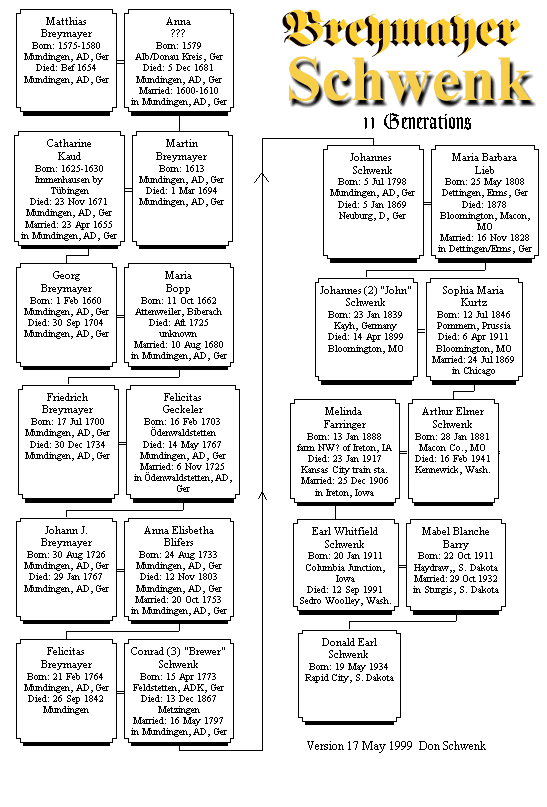
Little Matthias was being rocked in his cradle sometime between 1575 and 1580 in Mundingen. This estimated time of birth is based on his later wife's documented birth year of 1579. His father was probably Jacob. We do know, again from Dr. Kiess' book, that a Martin, a contemporary of Matthias, was definitely a son of Jacob. In 1679 and 1688 we find two marriages between two grandsons of our Matthias and two granddaughters of Martin. This fact suggests to the writer that the common great-grandfather of these four was Jacob, the couples being second cousins to each other.The First Generation
Matthias Breymayer, Farmer
The Second Generation
Martin Breymayer, Farmer,
Judge, Heiligenpfleger
The year was 1613,
seven years before the Mayflower would touch the shores of Cape Cod. Life
in Mundingen was peaceful, and the economy in Old Württemberg was
flourishing. The population was growing. But our Martin would see all this
come to an end when he was a young man age 21. That was in 1634 when the
wrath of the Thirty Years War would strike Mundingen and the surrounding
region full force. He would see the population of his village shrivel
to less than one-fourth its prewar figure. This depopulation would be a
result of flight to the protection of walled cities, of death at the hands
of the Imperial troops, of starvation and the plague which ravaged the
region in the years following 1634. He would witness the removal of seven
of the thirteen plows in the community which would be melted down into
bullets and cannonballs. He would see one-third of the houses and granaries
in Mundingen destroyed or no longer usable. And he would see weeds and
brush choking much of the farmland because of the lack of farm labor, plows,
and draft animals. We can scarcely imagine the horrors, the grieving, the
suffering and privation and hopelessness experienced by Martin and his
family.
Sometime before
the spring of 1655, Martin was courting a certain Catharina Kaud.
She was the daughter of Jerg Kaud of Immenhausen near Tübingen. It
was common for men from small villages to find their brides in communities
outside their own, and in view of Mundingen's population hovering around
60, this is not surprising. They married in Mundingen on April 23,
1655.
Their first child
was Matthaus, "Mathay", born 11 Sept. 1657. He married a Barbara Ilg, a
local girl, on 20 May, 1679. He died in January, 1733. The second
child was our Georg. He made his debut on Feb. 1, 1660. More about him
in the following chapter. The next child born was Matthias who appeared
on about the first of January, 1664. He married Anna Catharina Zaininger,
another local lass, on Aug. 30, 1685. He served as Schultheiss in Mundingen
1706-1728. He died holding that post on June 15, 1728. The fourth child
was Jacob. Birthdate was July 11, 1671. He died in infancy.
All four babies
were boys, as you have noted. Then their mother Catharina died on Nov.
23, 1671. The pastor failed to enter the age at death or cause of death.
She was probably younger than 50 at her death.
In the following
spring on June 16th, 1672, Martin remarried there in Mundingen. His wife
was Maria Bopp, a widow of Johannes Bopp, former mayor of Attenweiler
near Biberach, not far south of the Donau River. Her two daughters and
one son would join the Martin Breymayer household. These three children
would later marry there in Mundingen. The one daughter, Anna, would marry
Jacob Breymayer Jr., our Georg's first cousin. See next chapter for the
outcome of the other daughter, Maria.
Martin and Maria
did not bring any children into the world together. She was born in 1617
in Rottenacker just southeast of Mundingen on the Donau, and so at 55 years
of age she was past the child-bearing years with this second marriage.
When our Georg
was born in 1660, father Martin was shown as farmer and Heiligenpfleger.
If you recall, this was defined earlier as one who administrated the building
maintenance funds or finances of the local parish church. Church treasurer
is probably a more concise term. It was an important, but chiefly
honorary post; it doubtless required little of Martin's time, and
remunerated him accordingly. When Martin died, he was shown to have been
local Judge for 22 years. This entry was made on March 1, 1694. The reverential
wording of this death register entry reflects the high esteem this man
had in his community. And this is also reflected by the amount of offering
given at the funeral service, 26 Kreuzer (nearly ½ Gulden), far
more than the average funeral offering. The pastor also noted his age as
death, 81. And this birth year of 1613 is essentially confirmed when
in 1687, seven years earlier, the local pastor attempted to reconstruct
personal histories of some of his parishioners when he wrote,
"Martin Breymayer the older,
of Mundingen, approximately 75 years of age, was born of lawful and
Christian parents." And just to the left of this entry at the edge
of the page were the words, "Father, Matthias, Farmer; Mother, Anna was
very old, 102."
A death date
of Martin's widow Maria was not found nor searched for.
The Third Generation
Georg Breymayer, Farmer,
Heiligenpfleger, Mayor
The year is 1660.
The Plymouth Colony survived that first winter forty years earlier and
is now thriving. Across the Big Water in that tiny out-of-the-way Lutheran
community Mundingen, an enclave just outside the boundaries of Old Württemberg
but ruled by it, and surrounded by Catholic communities which lend even
further to its isolation, its economic and social life is only beginning
to resemble the times before 1634; its population, however, would not grow
back to the prewar figures until between 1835 and 1847. And so it was in
this year on Feb. l, that our ancestor Georg was born.
Jerg, a nickname
for Georg, grew up with two brothers, a stepbrother and two stepsisters.
One of those was Maria Bopp, 2½ years younger than Jerg. They must
have gotten along very well, for he asked for her hand sometime before
their wedding on Aug. 10, 1680. And judging by the great number of children
they would bring into the world, they continued to get along very well.
We know that three of those fifteen children survived and married - the
one most important to us, Friderich. We know that six died in infancy.
A search was not made as to the outcome of the remaining children, however
we know through Cousin Dr. Helmut Breymayer, that Magdalena, one of those
three who married, had children and one of her descendents lives today
in Silver Spring, Maryland; he is Ken Simons, another of our cousins. She
married at the extraordinarily young age of 15.
As were all the
Breymayers in those days, Georg was a farmer. Sometime after his marriage,
he acquired ownership of the small farm - approximately 8 acres - which
belonged to House # 7, the future Hirsch Inn. His son Johannes was shown
in 1713 as the owner of the much larger adjacent farm. These two properties
were one large farm back in 1649 when Jacob Breymayer, Georg's uncle,
purchased it from the Monastery of Urspring. How Georg and son acquired
these was not documented in Dr. Kiess' book. Georg also possessed the Maierhof,
the large farm owned by Württemberg. His father had turned possession
of this over to him in 1691.
Like his father,
Georg became the financial administrator, the Heiligenpfleger, for the
local parish church. This title appears after his name when his fifth child
was born in 1688. And so it appears he took over this post from father.
He was shown as Gemeindepfleger for many years in the birth register pages.
This word means approximately that of community treasurer or vice mayor.
This was an honorary position, but an important one, just as is the case
today in small town America. He was not the top dog, however; that was
the village Schultheiss (village mayor/marshall/judge. There is no good
English equivilent).
Georg was requested
and served very often as Godfather at christenings. On that subject it
is interesting to learn that in old Württemberg only two people -
a man and a woman - were allowed to serve as Godparents unless the infant's
parents were "important people." When a pastor recorded the christening
of his own child, there were nearly always four or five Godparents' names
entered. And this also held true for the Schultheiss, an esteemed
schoolmaster, etc. When Georg and Maria's son Friderich (ours) suffered
this wet and frightening ceremony, the Godparents were a clergyman from
nearby Dapfen, his wife, Georg's brother Matthias, and Catharina Semmindinger,
wife of the then Heiligenpfleger. And so it is clear that Georg was an
important man in his community.
Sometime in 1704 before he had reached
the age of 42, George fell ill. He died on Sept. 30 that year. Cause of
death was listed as hitzige Krankheit which translates to: "acute malady
or disease." That doesn't tell us much except that he died of natural causes.
His widow Maria apparently did not remarry. According to Dr. Kiess' book
in the section covering the history of the 11 farms, she sold one-half
of a Fief or "lease" on the "Grosser württ. Hof", also called "Maierhof",
to her oldest son Johannes in 1710. And in 1726 she sold House # 7, the
"Hirsch" property, to her youngest son Friderich; this was the year of
his marriage.
Persistent searches
were made through the death registers for her death date without success
(Cousin Dr. Breymayer also could not find this entry). We know from her
date of birth of 11 Oct. 1662 that she was age 64 when she sold the "Hirsch"
property to Friderich. Thus she remains as one of very few ancestors
whose death date was not found.
Fourth Generation
Friderich Breymayer,
Innkeeper, Brewer
Now it's 1700,
the dawn of the Age of Enlightenment in the Western World. And with it
was ushered in little Friderich. Once again, let us put this year in historical
perspective. The world would have to wait nearly six years before experiencing
the birth of our Ben Franklin; 32 years before George Washington's entree,
and 49 years until the birth of Germany's Johann Wolfgang von Goethe. And
it will be 76 years before our Colonies become an independent nation.
As in the foregoing generations,
we will try to sketch an outline of this man and his wife, drawing the
scanty data from church books and the scholarship of Dr. Rudolf Kiess.
Friderich was
only four when his father died. We know that his mother did not marry
again - at least prior to 1727 - and so he must have been raised by her.
His older brother Johannes was age 21 when their father died, and he may
have served as a sort of head of the household until his marriage in 1709.
And this is all we know about Friderich until the year 1726.
On November the
6th of that year, Pastor Wolfgang Friderich Blifers took quill in hand,
dipped it in ink which would often fade into illegibility, and proceeded
to record the nuptial event in the Ehebuch. As we shall later see, he was
a good man, but his penmanship was horrible! And that, coupled with the
cheap ink, lead this researcher often into despair. And it may be that
our Maria Breymayer's name lies undeciphered somewhere on the pages of
his death entries.
Another very
odd aspect of Herr Blifers' recording of this marriage is that it was entered
on the right edge of the page. The page records four marriages besides
the one under discussion: one in 1724; one in 1725; one in 1728 and
the last one in 1729, and with no space left between those entries.
It is almost as though Parson Blifers entered this 1726 event after the
1729 marriage. Or was this meant as a mean spirited gesture, his and the
Church's dim view of such an affair? (clarification appears seven lines
down). It seems we are coming up with more questions than answers
in this chapter!
In any event,
he recorded the marriage of our Friderich Breymayer and Felicitas, daughter
of Jacob Geckeler, the Schultheiss from Ödenwaldstetten, a village
north of there. An eleven-word undeciphered sentence follows the above
information. A best guess it that this had to do with an event which had
occurred about nine weeks earlier there in Mundingen.
That event was
the birth of Johann Jacob Breymayer, and the date was Aug. 30th. The parents
were our Friderich and Felicitas. Why did they wait so long to see the
preacher? He was old enough. Did the schoolmaster over in Ödenwaldstetten
have some objections? Did Felicitas not really care for this young man?
Had Fridrich not yet fulfilled the requirements of the State that he possess
a rifle and sidearm, a fire brigade bucket, or had not yet planted
two fruit trees on communally-owned land and cared for them to their fruit-bearing
stage in order to have the right to marry? Who knows? Perhaps this
delay in "getting to the church on time" was connected to the sale of the
"Hirsch" property to Friderich by his mother that same year.**
According to
the Kiess book, Friderich, in the early part of this century, built
a brewery building directly adjacent to House # 7. Apparently he did this
around 1726, the year he acquired this property. He then converted part
of the house to an inn, the "Gasthof zum Hirsch", which as we already know
is still in business today. Where he had learned the skills of brewing
beer is unclear. There had apparently been no brewery in Mundingen prior
to this. He obviously had learned this trade outside his village. Dr. Kiess
states in a section which describes a brief history of the "Hirsch" and
two other such businesses, that Friderich had "come from Lauterach." That
is a village just over the hill near the Donau. And so it is probable that
he went there several years prior to 1726 and worked as an apprentice with
dreams of later owning his own brewery and pub in his home village.**
He and Felicitas
brought five more babies into the world. They were: Johann Friderich, Anna,
Catharina, Johann Friderich. Johannes was their last child. He was born
in 1733. He died in 1755, apparently not having married. All the others,
except for the firstborn Johann Jacob, died in infancy or in childhood.
Life for Friderich
came to an end on Dec. 30, 1734. Our Rev. Blifers failed to enter the cause
of death in the death register. In 1736 with three young sons to care for
and a business to run, Felicitas remarried. Perhaps she had hired a brewer
to run the brewery next door and then grew to care for him. In any
event, on April 24, 1736, she married Hans Jerg Koz, a brewery worker
from nearby Rottenacker. We learn, again from Dr. Kiess, that Hans in 1753
bought the property of House # 45, just down the street with the idea of
"perhaps getting rid of the competition." Earlier, that building had served
as the local Rathaus, village hall, and its owner had a very small wine-tavern
business there, but really hardly a tavern, in that it did not even
have a sign hanging above the door. In any event, Hans and Felicitas then
had the "monopoly" on the tavern and lodging business until around 1782
when a new inn called the Adler was built just on the east edge of town.
But that place would not give them any competition, for they both died
before the Adler was built. Hans died in 1763; Felicitas died on May 14,
1767, both in Mundingen.
**Wrong! Subsequent to the writings above, I traced Felicitas Geckler's ancestry in Ödenwaldstetten. She and Friderich married there on 6 November, 1725, some ten months before their first child was born. Either Grandpa Blifers wrote down the incorrect year of marriage, or I misread this. Also of significance is the fact that Felicitas' father was an innkeeper in Ödenwaldstetten as well as the head honcho of the village. I now believe that Friderich Breymayer learned his brewing and innkeeping skills from his father in law.
The Fifth Generation
Johann Jacob Breymayer,
Innkeeper, Brewer
Johann Jacob was
born on Aug. 30, 1726. He was the firstborn of six and the only one to
survive and marry. There was at least one other Johann Jacob Breymayer
in Mundingen and so he was referred to as Johann Jacob der Wirts Sohn,
the innkeeper's son. He was eight years old when his father died. At that
time he had two brothers still living, a Johann Friderich and Johannes.
As we learned above, his mother remarried in 1736. It seems clear he learned
the art of brewing from his stepfather, Hans Jerg Koz, and how to run an
inn from his mother and stepfather.
When he was 27, he ambled over to
the residence of widow Anna Agnes Blifers to have a talk with her regarding
her 20 year old daughter, Anna Elisabeth. He had known this young woman
since she was a child and was very fond of her. She had said yes.
The visit was
fruitful. The wedding took place on Oct. 20, 1753. They then took up residence
in his mother's home, the Hirsch Inn. His mother and stepfather apparently
then moved into House # 45, the property which H.J. Koz had purchased that
same year - the former "minor competition" of the "Hirsch." It appears
that Johann Jacob was then running the brewery and inn. When his
stepfather died in 1763, the "Hirsch" property was deeded over to him.
Some of the evidence for the above
comes to us once again through the scholarship of Dr. Kiess. On pages 242-243
in his book, we find a list of all the adult inhabitants of Mundingen in
the year 1764. In that year there was a special "military tax" levied on
the subjects of the Duchy of Württemberg. We see there the name
of Felicitas, widow of H.J. Koz. After his name appears the occupation,
baker. So now we know he baked as well as brewed! Her residence was
in House # 45. Her buildings and land were appraised at a value of 878
Gulden. She owned four head of cattle, two sheep and one pig. Two Gesinde,
worker/servants, resided under her roof. Her total assets show to be 955
Gulden and a few Kreuzer. These assets put her in tax class # 6, with class
# 1 the poorest, # 10 the wealthiest.
Now let's return
to the family of her son J. Jacob. Their first baby was born in 1755. This
baby died as an infant. Six more babies would be born into this family,
the last in 1766. Five children lived to adulthood. Marriages could not
be found for any of those except for their daughter Felicitas, born Feb.
21, 1764, our beloved Felicitas
What follows is a digression from
the Breymayer story, but it deserves telling. It has to do with a very
interesting direct ancestor of ours who played a small part in Mundingen's
history. In 1762, the mother of Anna Elisabeth died there in Mundingen.
She, Anna Agnes Blifers, born Kuser, was age 69 when she died. She was
born probably in Tübingen, the university city, not far south of Stuttgart.
In around the summer of 1729 there, she married a recently widowed clergyman,
Herr Wolfgang Friderich Blifers. Herr Blifers birthplace was also Tübingen;
his birth date was May 25, 1685. His father and father's father were bookbinders
in that city. He studied theology at the University of Tübingen. His
first wife had been Eva Maria Angler and the marriage took place almost
certainly in his home city and probably shortly before receiving his first
pastorate in Mundingen in 1719. Their first child was born in Dec.
1719; their sixth in Feb. 1727. Eva Maria died in Mundingen on Sept. 27,
1727. And as said above, he then remarried to our Anna Agnes Kuser. The
only child born of this union was our Anna Elisabetha, 24 Aug. 1733.
In a section
of his book, Dr. Kiess listed all the pastors of this parish church
from the Reformation through 1983, and described briefly something of their
contributions to the community and/or personalities. His sketch of our
W.F. Blifers is very interesting and enlightening; therefore a translation
of that by this writer (and likewise descendant of the subject) is
included here.
"Wolfgang Friedrich Blifers (Pastor 1719-1752) from Tübingen
He was born in 1685 and was a
rather unfortunate figure. After a long wait, he received in 1719 his first
and....last pastoral position. He was a restless spirit, and it is no wonder
that it was said: 'He loves to leave and run off to visit his homeland
in Tübingen.' In 1725 the Examiner writes about him: 'One can find
little fault in his diligence. He has no coarse vices; however his tendency
to get into arguments is ruinous for him. Because he here is totally surrounded
by Papists, he often goes to Munderkingen to the Market on Saturdays and
gets into religious arguments with the Catholic farmers, who recently,
because of his zeal, should have been repaid with blows. He flatters himself
somewhat in that he has presented birthdays poems to the Prince of Messkirch,
Lord Baron Späth von Schültsburg, the Prelate from Ober-Marchtal
and even to the Catholic innkeeper in Granheim, from whom he was repaid
partly with wood and a drink. I have forbidden this activity by him
in a friendly but stern manner.' One could not, of course, trust
him to refrain from this sort of behavior. He was considered an educated
man who could even read French, and the Examiners seemed disposed to grant
him a different pastorate. In spite of a poem devoted to the Duke, he was
unsuccessful in being relocated in this, 'in the middle and among
Papists situated pastorate.' (1736) 'and where the Catholics lay in wait
for him.'
All his requests
were for naught. He had to remain in his unloved pastorate until his death
(11 Oct. 1752). The community regarded him highly, and he became in many
respects sedentary. In the course of years, he acquired 10 Jauchert* of
farmland, and in 1753 his daughter married the Hirschwirt Breymayer,
another to the cabinetmaker Friedrich Bolay, the son of the Forest Adminstrator.
One son worked in an office, another with a stocking knitter. At home,
he didn't have it easy: 'His morals appear to be better than previously
because his present wife claims to hold him in check', it was said in 1731,
and later: 'He is subservient to his mean wife.'
A gifted
man, a good preacher, who was perhaps irreconcilable, and had a slight
speech impediment, foundered in the rural world." Ed. note: A
Jauchert = slightly more than one acre.
Our Grandpa Blifers was not the only clergyman who was less than pleased with his post in Mundingen. Only 18 years before he arrived there, the local parson was an Andreas Kuon. He only stayed there three years. He often complained about his flock not attending church regularly, and that he often held the church service "almost alone." In 1704 his apparent prayers were answered and he was granted a new pastorate. Before departing, he entered his comments of "gratitude" onto a page in the birth register thanking God for not having rejected his plea to leave that place. He also wrote, "I leave here as Lot left Sodom." He had, with foresight, penned these words in Latin, and only his successors and a scholar like Dr. Kiess would ever understand his departing comments. Dr. Kiess commented that, "It is not known whether his wife turned to a pillar of salt."
And now back to
the Breymayer story. In the same military tax list of 1764 mentioned above,
we learn more about our J. Jacob. He was shown as "Wirt", owner of House
# 7. Buildings and land assessed on a value of 1307 Gulden. He owned five
horses, 10 cattle, three sheep and two pigs. Total value of livestock:
226 Gulden. Total assets: 1719 Gulden. Tax class # 8. Five children at
home; three workers/servants. His tax for the year was nearly 14
Gulden. That amount of money might be equivalent to a good milk cow.
The year is 1767.
A tragic year for this family. On January 24, seven year old Jacob Friderich
died of convulsions, or Gichter. This was an disorder of the
digestive organs and a very common cause of death among children. Just
five days later, our Johann Jacob followed his son to the grave. The recorded
cause of death was Stechen im Munde, probably a term for diphtheria. For
now, this natural cause of death defies definition for the writer. And
then in the May, Felicitas, the mother of recently deceased Johann Jacob,
died of "inneren Brand"; this was very probably the term then for
cancer.
Poor Anna Elisabeth!
Five young children to care for and a business to run. She was then not
quite 34 years of age. And so because we lack the facts, we can only guess
she may quickly have put out the word that the "Hirsch" was in need of
a brewer, perhaps the same as her mother had done back in early 1735. What
we do know is that a man named Elias Fischer from Weilheim appeared on
the scene and married our widow Anna Elisabeth on July 25, 1768 in Mundingen.
He must have been a brewer by trade, for one does not learn those skills
overnight. In that same year, the ownership of the Hirsch property and
that of House # 45 was transferred over to Elias, which followed the law
when a widow remarried.
Our little Felicitas
was not quite three when her father died, and so Elias was really the only
father she would know. In the Schwenk section of this story, Elias and
his role in the family was discussed, and so it is time to conclude this
story of our Breymayer ancestry. We already know that right at the end
of that century, the Breymayer "tributary" joined the "main stream" (our
point of view, only) of the Schwenk lineage. That occurred in 1798 with
the birth of our Johannes Schwenk. And he is the one who has transmitted
to us our proud and honorable Schwenk and Breymayer ancestry. And then
in the years of 1830 through 1840, as we have already seen, the Lieb
tributary joins our stream of ancestry with the birth of Maria Agnes Felicitas,
Luise, John and August Schwenk.
These are just
three of the many lines our our ancestry in Germany. We learned a little,
or at least their names were mentioned, of the others: Sauter, Hilsenbeck,
Mangold, Ostertag, Harscher, Kauder, Laur from Laichingen and Feldstetten.
And in Mundingen the family names of: Kaud, Bopp, Blifers, Kuser and Geckeler.
And west of there in the Pfullingen area and Dettingen, the families which
joined the Lieb line: Bansovius, Eberhardt, Gwinner, Häring, Handel
and others. We all carry a little bit of all of them in our veins.
It would a bit
inappropriate, no, pointless to offer them our collective gratitude. They
probably are not listening anyway. They simply did what people do; make
love, have babies, care for them and hope they grow up and do the same.
But if perchance the spirit of Anna Ursula Schwenk, born Ostertag, is listening
right now, here Grandma Anna is a heartfelt THANK YOU for saying ja to
old man Conrad back in 1771!
The End